

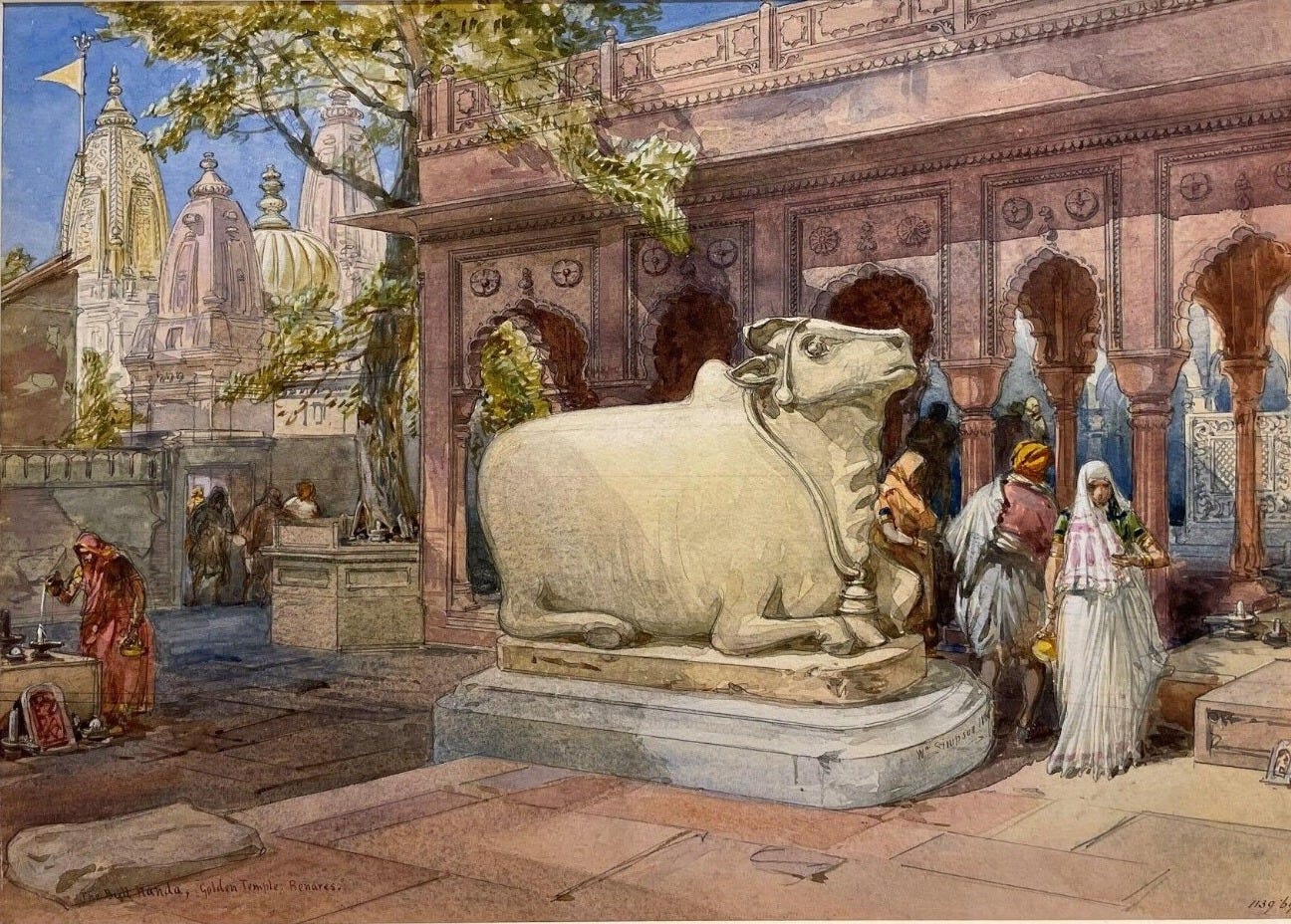
In Review: The Idol Thief: The True Story of the Looting of India’s Temples. S Vijay Kumar. Juggernaut Books. 248 pages.
Introduction
S Vijay Kumar’s The Idol Thief: The True Story of the Looting of India’s Temples reads like a true-crime thriller about a suave Manhattan art dealer, Subhash Kapoor, and how he stripped the temples of Tamil Nadu of the custody of their bronze gods, selling them to great museums until an improbable band of amateurs decided to end it one day. The word custody does not serve just a sentimental purpose. It is proprietary, and Indian law has said so for a century. A consecrated murti is a juristic person: it owns, it holds title, it sues.
In 1991, an English court accepted as much and handed a Chola Nataraja back to a Tamil temple that had lain in ruins for centuries, against a Canadian company that had bought it in good faith. It is important to understand that no buyer in this circumstance could plead innocence, as it was still taken from custody. Everything in Kumar’s book—the glued lock, the shell company, the accession number—sits downstream of that single fact. This review takes it upstream, and then asks the question the book cannot: holding the strongest restitution claim in the world, why did India not take the initiative earlier? Read as a caper, it is Money Heist told in reverse—the crew assembles not to empty the vault but to refill it, though the anthem underneath is older music: a civilisation asking why its gods keep ending up behind foreign glass. The book’s deepest subject is the matter of custody: a clear determinant of who holds a civilisation’s sacred objects, and what it means that for more than two decades of governance post-1991, the state could not do what a network of volunteers had to. The review also explores the emerging strategy of the new state developing diplomacy as a tool of this restitution and bringing the Lords back to their abode. This response is analysed as a potential answer to the question raised.
Robbing the Vault for the Temple
The book’s primary backdrop is the looting of the Suthamalli and Sripuranthan bronzes, and the mechanics around it, as Kumar reconstructs them, are almost simple. The target was a half-forgotten Brihadeshwarar temple at Sripuranthan, in Ariyalur district, not the Chola monument at Thanjavur but a shrine that had not been under active worship for the better part of two decades. The local fixer was Sanjeevi Asokan, who knew the topography of Tamil Nadu’s ancient temples much like the way a burglar knows a floor plan. One night in January 2006, two hired men broke the lock, lifted three of the eight bronzes inside, then glued the lever of the broken lock back into place so that nothing would appear amiss. The hired men were paid INR 2 lakh for the night’s work. In May, they returned and took three more. The idols were routed through a shell freight company to Kapoor’s New York firm, the splendidly bland Nimbus Import Export, and Asokan was wired more than INR 1 crore from Kapoor’s bank account in Manhattan.
For the book, however, the heist from the vault was the one that brought the statues back to their abode. In Kapoor’s case, it was the Western museum. The redemption crew led by Kumar is good at the legal wall that the loot had to climb. Under the Antiquities and Art Treasures Act of 1972, no antiquity over 100 years old may leave the country, and under the 1970 United Nations Educational, Scientific, and Cultural Organisation (UNESCO) Convention on the illicit transfer of cultural property—a recipient state is obliged to forfeit such an object without compensation once it is shown to be stolen. With these in place, a bronze with a Tamil temple’s name still legible on its base ought to have been radioactive. However, Kapoor was able to avoid any sort of accountability as his gods walked through the front doors of the National Gallery of Australia, the Asian Civilisations Museum in Singapore, the Toledo Museum of Art, and the Brooklyn Museum. The Sripuranthan Nataraja alone, the ‘Dancing Shiva’, was acquired by Canberra in 2008 for around 5 million dollars. A prohibition or a law that stops no one is just a formality, and the question should be raised about those galleries that Kapoor walked into and chose to treat the law that way.
The genius of the operation was a whole laundering machine working at the other end, and that machine ran on the willingness of respected institutions like those mentioned, that asked too few questions about objects they wished to own. Hence, the book might just show the robbery of the temple, but the vault is the ability to extend beyond that, to go within these institutions and retrieve the heritage.
The economics of this operation, however, are plainly colonial. There is a concept of global value chains in economics where the multinational corporations in the Global North extract raw materials and exploit cheap labour from the Global South, mirroring historical colonial exploitation. The effect of this colonial commodity ledger has reached the way the idol thieves work. The men who lifted the bronzes earned a lesser sum. The Sripuranthan Nataraja, once it had passed through Kapoor’s gallery and acquired its laundered respectability, fetched around 5 million dollars in Canberra. Value was created at every step away from the temple and captured almost entirely at the far end of the chain, the classic structure of extraction in which the source community is paid a pittance for the raw material and the certified asset commands a fortune in the metropolitan market. The Tamil village was robbed of its God, Manhattan supplied the paperwork, and at the end of it, Canberra supplied the cheque. However, the object was not a sack of indigo or a chest of opium but a living deity changing the moral temperature without changing the commercial logic, and it is the commercial logic that the book lays bare almost despite its thriller instincts.
Provenance as Willed Blindness
If the museum is the safe house, the disguise that gets the loot past the door is provenance—the paper history of who owned an object before. Kumar shows in granular detail how Kapoor manufactured these histories. His associate Selina Mohamed prepared false provenances which were derived from an earlier partner of Grace Paramaspry Punusamy, who ran a gallery in a tired Singapore mall and had for years signed ownership records that gave Kapoor’s hot bronzes a cool, invented past. When questions surfaced on the Brooklyn Museum’s own blog, the institution’s response amounted to this: we have done our due diligence, we cannot share details, trust us. The most damning thing the book establishes is that the mask was thin. Kumar’s framing treats the museums largely as victims of a clever fraud, but they were not victims because they were the demand in this value chain. The international trade in looted antiquities is not a supply-side accident that was a result of a few temples carelessly guarded. It is a market, and a market clears because someone is buying at the end of the value chain.
The pattern was notorious before Kapoor. Jason Felch and Ralph Frammolino’s Chasing Aphrodite, published in 2011, documented how the J Paul Getty Museum built a world-class antiquities collection on objects whose provenance anyone with eyes had reason to doubt. The acquisitions committee that enjoys a lavish private viewing, accepts an authentication from a tame academic, and pockets a few free artefacts to sweeten the deal is definitely not being deceived. It is choosing not to know, and it is choosing to keep its eyes shut. Kumar himself was more than a theorist to experience this, but still dramatises the confidence trick beautifully. In that process, what he leaves underdeveloped is that the trick requires a willing buyer on every continent. The Manhattan District Attorney’s most recent Indian repatriation proves it better than any argument. Among the 657 antiquities returned on 28 April 2026 was a sandstone dancing Ganesha, looted from a Madhya Pradesh temple in 2000 by one of Kapoor’s indicted co-conspirators, passed to the convicted trafficker Vaman Ghiya, sold on to the New York gallerist Doris Wiener, given a fresh false provenance after her death by her daughter Nancy Wiener—herself later convicted of trafficking—and sold in 2012 through Christie’s. Five hands touched that object between the temple and the saleroom, and the last belonged to the most reputable auction house on earth. Returned in the same tranche was a red sandstone Buddha valued at 7.5 million dollars, seized not from a museum but from Kapoor’s own New York storage unit, where it had simply been waiting for a buyer. The trade was never hidden. The mask never had to be convincing because the buyer was holding it up to its own face. Willed blindness deserves a consequence. A market that declines to inquire cannot later plead the innocence that inquiry would have destroyed.
The State Vacated the Field
The Idol Thief has two masterminds, and neither is ever in the room. Kapoor is the Professor of the looting, the impeccably suited dealer on Madison Avenue, near the Metropolitan Museum of Art, who never once touched a crowbar and orchestrated everything from a distance. His mirror image, and the book’s true protagonist, is Kumar himself, a shipping and finance professional based in Singapore, with roots in Chennai, who built the counter-operation the same way. The recovery ignited during the times of the newly powerful internet, where part of the recovery was conducted through museum websites, auction catalogues and Google Street View, scrolling past the polished vitrines of distant museums looking for a face reported missing from a Tamil village. Kumar formed the India Pride Project, a volunteer network roughly 200 strong that he co-founded with Anuraag Saxena. It was an irregular crew straight out of the genre that included a United States law-enforcement officer, whom the book can only call ‘Indy’ to protect him, the journalists Felch and Michaela Boland, the iconographer Kirit Mankodi, and the dogged Tamil Nadu Idol Wing Criminal Investigation Department (CID) officer Selvaraj, who worked his way up from the runners to the kingpin. The break came from a spurned partner: Punusamy, having lost a bitter suit to Kapoor in Singapore, left an unguarded comment on a museum blog in April 2009.
This counter-heist was run by civil society because the state back then had vacated the field, and that is the most important and least comfortable revelation in the book. It is a revelation that should ideally raise questions. It should not be allowed to dissolve into the warm glow of the underdog narrative. A civilisation that produced the Chola bronzes, the supreme achievement of metal sculpture anywhere, had, after its independence, outsourced the custody of its own gods to a social-media group and a Singaporean professional’s evenings. The forensic backbone of nearly every recovery was not Indian at all. For example, it was the photographic archive of the French Institute of Pondicherry, which has documented Tamil temples since 1955, and whose 1994 images of the Sripuranthan idols in situ became the evidence that nailed Canberra. The heroes are admirable precisely because they completely volunteered to take up this task. However, a heritage power that was dependent on volunteers for its heritage is announcing a structural failure and not a triumph. Kumar knows this—his anger at the apathy of the temple administration bureaucracy is audible throughout—but the thriller form lets the reader feel rescued rather than indicted, and I insist that the reader ought to feel both.
There is an asymmetry of arms worth dwelling on because it sharpens the indictment into something useful. On one side stood a global trade with dealers’ capital, museum endowments, tame authenticators, and the inertia of institutions that did not wish to look too hard at their own shelves. On the other stood a handful of enthusiasts cross-referencing auction catalogues against a French archive in their spare hours. So, the fact that the amateurs won as often as they did is a testament to the open-source method, the realisation that the very publicity the trade depended on, the glossy catalogue and the proud museum webpage, was also its vulnerability, since a God photographed in a vitrine could be matched to a God photographed on its plinth. A recovery model that depends on the looters advertising their loot, however, catches only the careless and the vain. The bigger and unsolved problem is that the quiet sales, the objects that go straight into a private collection and are never published, remain invisible to it. The book is an account of a participant who found a successful method, but the very nature of the success reaches far less than custody should restitute.
An Owner with Standing
As Indians, we must ask, what exactly is the thing that was stolen? In an interview around the book’s release, Kumar was characteristically blunt about the trouble with his own title, that ‘idol’ carries a foreign, faintly pejorative charge, and that the right word is murti. The distinction is not pedantry because a consecrated murti, awakened through the rite of prana pratishtha, is not, in Hindu understanding, a representation of a deity and instead is the deity’s living presence like a person resident in bronze. The book’s prologue enforces this living presence. In the eleventh century, an artisan did not so much sculpt Nataraja as coax him alive in the metal. Three centuries later, a priest buries the bronzes to save them from the cavalry of Alauddin Khilji’s general Malik Kafur, and charges his son to one day dig them up and restore his Lord to his rightful abode. This is why the two sides can never quite be talking about the same object. To the museum, it is a Chola-period artwork—an old and beautiful thing. To the temple, the same bronze is a living God who has been carried off against his will. One side of this equation has lost a person while the other has gained a thing.
This is where India’s argument becomes distinctive, and where the book stops short. The universalist museum has a stock defence which is that great art belongs to humanity, and the cosmopolitan vitrine is its proper home. India’s answer is not the immediate sentimental one that the object would be happier back home. In Indian jurisprudence, the deity is a juristic person; it can own property, and it can sue. The principle is not a novelty invented for this dispute. It descends from a century of Hindu endowments law—the Privy Council in Pramatha Nath Mullick v Pradyumna Kumar Mullick (1925) recognised the consecrated deity as a juristic person, a perpetual minor whose interests are managed by its shebait, capable of holding property in its own name. The doctrine drew scholarly attention immediately. It is not a curiosity of temple administration, but the ordinary law of Hindu religious endowments, and it has been carried into the constitutional core. In M Siddiq v Mahant Suresh Das (2019), the Supreme Court accepted Bhagwan Sri Ram Virajman as a juristic person and decreed the disputed land to him—while declining to extend personality to the land itself. The Court was drawing a line that makes the doctrine usable. The deity is a specific, identifiable thing—this consecrated bronze, in this temple—so a court can rule on who owns it. A stretch of sacred land, or a feeling of holiness, is too vague for a court to grant rights to. By keeping the personhood narrow and concrete, the law keeps it enforceable. This had been tested and upheld not in a sympathetic Chennai courtroom but in London. In Bumper Development Corporation v Commissioner of Police of the Metropolis (1991), a Chola Nataraja unearthed by a labourer near a ruined Tamil temple at Pathur had surfaced on the London market and been bought by a Canadian oil company. The English Court of Appeal accepted that, under the law of Tamil Nadu, the ruined temple itself was a juristic entity capable of suing, and that the reinstated Shiva lingam at the site could appear as a claimant. The company lost. Two features of that outcome deserve more weight than they have received. The Pathur temple had lain in ruins, unworshipped, not for 20 years but for centuries, and it won anyway. The trial judge found that the pious intention of the thirteenth-century notable who endowed it survived him and was personified by the building. Bumper had bought openly, paid market price, obtained an export licence, and sent the bronze to the British Museum for conservation—the conduct of a purchaser with nothing to hide, which is what it was. Four years later, the Alberta Court of Queen’s Bench enforced the English judgment and dismissed its plea of unjust enrichment and set a precedent. A God, through his temple, had recovered his own image in an English court. The implications reach beyond one case. If the deity is the owner, the title never passes to anyone in the chain—not the thief, not Kapoor, not the museum. Good-faith purchase is no defence against a claimant who never consented to sell, and no accession number can cure a void title. This is what converts India’s position from just a diplomatic plea into a valid property claim: the bronze is a person, an owner demanding restitution of himself.
The Claim India Did Not Make
If the volunteers filled a vacuum, it is worth asking what exactly the state was not doing while they filled it. The answer is not merely that it failed to guard the temples. It is that, holding the strongest restitution claim available to any source country in the world, it had declined for decades. The first occasion was the Sivapuram Nataraja, and it is the ancestor of everything in Kumar’s book, though the book has no room for it. Six tenth-century bronzes were unearthed in a Thanjavur field in 1951 and placed for safekeeping in the nearby Sivagurunathaswamy temple. In 1956 the Nataraja was sent out for restoration; the restorer, suborned, returned copies to the sanctum and released the originals into the market, where they passed through Bombay collectors to the New York dealer Ben Heller, who sold the God to Norton Simon in the early 1970s for a reported 900,000 dollars. India learned where its Nataraja had gone because the Metropolitan Museum announced an exhibition of Simon’s Indian collection in 1973—which is to say the state discovered its own loss from a press release. New Delhi then did something it has not done since. It sued in Los Angeles, and argued that the statue was not property at all but a legal entity able to sue on its own behalf, the first time that argument had been made anywhere in the world. It had Scotland Yard impound the bronze in London, and then it settled. Under the 1976 agreement, the Norton Simon Foundation recognised India’s title, and India lent the God back to the man who had bought him after he was smuggled, for ten years. The Sivapuram Nataraja reached Tamil Nadu in 1986 and sits today in a strong-room at the Kapaleeswarar temple in Mylapore. The God stolen from a sanctum was recovered in a vault. The Somaskanda from the same find is still in Pasadena. Asked by The New York Times whether the piece had been smuggled, Simon is reported to have answered: ‘Hell yes, it was smuggled.’ He later denied saying it. It hardly mattered. He had already won because he kept his showpiece for another decade, recovered his 900,000 dollars by suing Heller, and purchased the remainder of his collection. The second occasion was Bumper, and India did not choose that either. The company sued the Metropolitan Police in detinue and conversion for the return of its bronze, and the claimants—the Union of India among them—were drawn into an interpleader the other side had begun. The most consequential precedent in the law of sacred property was won defensively, in a suit brought against the police by a Canadian oil company. India turned up because it had been summoned. Since 1991 up until 2014, nothing. Not one action on foreign soil asserting the deity’s title.
Look, then, at how the gods have actually come home. The 157 of 2021, the 105 of 2023, the 297 of September 2024 were handed across at summits, between heads of government, as gestures. The 657 released on 28 April 2026 were let go by the Manhattan District Attorney’s office mentioned earlier. With Oxford’s Ashmolean returning the sixteenth-century bronze of Saint Tirumankai Alvar—bought at Sotheby’s in 1967, identified in 2019 against the Pondicherry archive by the same volunteers who found the Sripuranthan gods—the machinery that moved was a University Council resolution of 11 March 2024 and the assent of the Charity Commission for England and Wales that December. The handover took place at India House in London on 3 March 2026, seven years after an amateur found the saint on a museum webpage. India has taken the object every other claimant treats as a grievance and turned it into an instrument of statecraft. A God handed across at a summit does more than come home. For the returning government, the ceremony converts an embarrassment—the looted bronze sitting in the national collection—into a photographed act of respect, a favour banked with a rising power. The new state attempts to bolster civilisational confidence in the world as each handover quietly sets the norm that Indian sacred art is expected to come home, and that returning it is simply what a friendly state does. This is soft power in a nearly pure form, costing New Delhi almost nothing and yielding goodwill and precedent at once.
Litigation abroad is slow, costly, and reputationally hazardous; it demands evidence of a quality the state does not systematically hold; and it manufactures confrontation with friendly governments at precisely the moments when a ceremonial handover would manufacture a photograph. Diplomacy is cheaper than proof. However, the objects most likely to come home through diplomacy—the notorious, the vulgar, the ones a prosecutor has already seized—are exactly the objects for which the government has worked. The step forward is a doctrine needed for the quiet possessor: the private collection in Geneva, the small museum with a good lawyer, the institution that returns nothing because nobody has ever made it. Against that possessor, a plea is worthless, and a writ is not. Other claimants press their cases as standalone campaigns—Greece through decades of public advocacy, Nigeria museum by museum—while India has made the returning God a recurring set-piece of the summit itself, so that the civilisational claim and the diplomatic gain are weighed with the same importance, hence making success more likely at a bigger scale. No source country has folded repatriation so deliberately into the choreography of its diplomacy.
From Colonial Loot to Plain Law
It would be a mistake, and the book mostly avoids it, to treat this as a story that begins in 2006. The historian Nayanjot Lahiri, reviewing the book, reached back two centuries to a Bengali Brahman’s despairing question to a British missionary, ‘How is it that your countrymen steal our Gods?’ His Lakshmi had been carried off by night because he would not sell her, and while the tree she stood under remained, the Goddess was gone. This episode and the Kapoor network are the same crime separated by an empire’s lifespan. The collections of the great Western museums were assembled, in no small part, through what Lahiri unsparingly calls colonial loot and archaeological rapine. However, what changed after 1947 was the mechanism, while the flow remained the same. The state withdrew, and the market took over, and the loot kept moving outward. By the estimate of Kumar and his collaborators, tens of thousands of objects since 1980 alone. India’s neighbour Nepal had at least named its losses: Lain Singh Bangdel’s Stolen Images of Nepal appeared in 1989. India, for decades, did not keep the photograph that would have let it prove a theft. The comparison with the more famous restitution quarrels is instructive, and it flatters India’s case rather than the reverse. The two claim-types have opposite structures. One asks for grace, and the other asks for judgment. Conflating them is a downgrade, and it hands the universalist museum the reply it most wants, which is generalising the fact that all restitution claims are ultimately political. The Parthenon Marbles in the British Museum, the Benin Bronzes, the manuscripts carried off from Maqdala are the set-piece disputes of the repatriation age, and they are hard precisely because the taking happened so long ago under the colour of a vanished sovereign’s authority, in a legal vacuum the present cannot easily reach. The Kapoor objects are different in kind. They were stolen in living memory, in clear breach of a 1972 statute and a 1970 convention both still in force, with the temple inscriptions often still legible on their bases and, at Sripuranthan, with photographs of the gods on their original plinths sitting in an archive. India demands to apply the laws already in force. The thefts are recent, the statutes they broke still stand, and the proof still exists, so the whole case rests on present law and current evidence. This lets New Delhi press a claim that is at once civilisational and strictly legal—a sovereign right asserted through evidence and now normalised as an act of restoring trust and respect in diplomacy.
This is where the loyal-critical reading must also be honest about what has changed, because the contrast with the era the book describes is stark. Building on the argument of diplomacy, the handover of the Sripuranthan Nataraja by Prime Minister Tony Abbott to Prime Minister Narendra Modi on 5 September 2014 was the first time independent India treated the repatriation of its sacred art as statecraft rather than charity. By the government’s own figures, only 13 antiquities were officially returned between 1947 and 2014; since 2014 the number has reached 657, of which 578—roughly 88 per cent—came from the United States alone. The recoveries arrived in batches negotiated at the level of heads of government: 157 in 2021, including a twelfth-century bronze Nataraja, 105 in 2023, and 297 during Modi’s visit in September 2024. Most consequentially for the long term, India and the United States signed their first-ever Cultural Property Agreement on 26 July 2024, at Bharat Mandapam on the sidelines of the 46th session of the World Heritage Committee, which India was hosting; the agreement carried no operative import restrictions; those arrived a year later, when US Customs and Border Protection promulgated the Designated List by final rule effective 28 July 2025, running to 26 July 2029. It restricts the import into the United States of Indian archaeological material and routinises its seizure and return, making India a bilateral partner of Washington. Behind these state-to-state transfers stands the machinery the book set in motion because, under Operation Hidden Idol, the US Homeland Security Investigations (HSI) unit seized more than 2,500 artefacts linked to Kapoor, valued at over 143 million dollars, and Kapoor himself was convicted at Kumbakonam on 1 November 2022 and sentenced to a decade in prison. Modi, receiving the 2024 tranche, described the objects as forming ‘the inner core of its civilisation and consciousness’. Heritage retrieval has become an instrument of Indian diplomacy in a way it simply was not before.
Proportion is still owed, and the book itself supplies it. Against an outflow estimated in the tens of thousands, 657 returns is a beginning, and the credit belongs first to the volunteers who made the cases winnable, then to a state that took up the responsibility. The honest verdict is the unfashionable one in the middle. What the new India has done is real and without precedent, but it is also unfinished. The change deserves to be taken seriously, but it has not yet earned a victory lap.
The Front Door Is Still Ajar
The book’s limitations are, in the end, the limitations of its genre, and Kumar is candid about them. He has said that only about 40 per cent of what he knew reached the page, that one senior policeman he exposed went underground for three months, that the network’s full kingpin had still not been caught. A thriller written from inside an unfinished, dangerous case is necessarily partial. It dramatises the chase and cannot offer the audit. So the most important question the book raises is the one it is least equipped to answer, which is not about who stole the gods, but why they were so easy to steal, and whether the conditions that made the theft possible have changed.
Those conditions are domestic and structural, and they are where the argument needs the most strengthening. The looting of Sripuranthan was possible because the shrine had been left unworshipped and unguarded for two decades, and the temple-administration apparatus, by Kumar’s bitter account, treated thousand-year-old monuments with a mixture of neglect and fluorescent-lit vandalism. Nor did there exist any national archive of temple idols against which a theft could be checked—which is why the decisive documentation came from a French institute rather than an Indian one. Recovery, no matter how thrilling, only treats a symptom. The Comptroller and Auditor General (CAG) put numbers to it in 2022: of more than 400,000 heritage structures and more than 5.8 million antiquities, only about 184,000 monuments and 1.68 million antiquities had been documented at all. The National Mission on Monuments and Antiquities, launched in 2007 to build precisely the register whose absence let Sripuranthan happen, was folded into the Archaeological Survey of India (ASI) in 2017 with the work unfinished; the CAG found it had no strategy, no road map, and staffing inadequate to the task. Its budget allocation for 2024–2025 was in the region of INR 20 lakh. Set that beside 143 million dollars—the value of a single trafficking network—and the asymmetry becomes an explanation. The cure is custodial in its essence because of the serious national register of sacred objects, reform of the opaque endowment departments that hold multiple temples in trust, and a security regime worthy of the artefacts it guards. The diplomatic gains of the past decade are real, but they will be hollow if the front door is still ajar. A heist story can tell you that the vault was robbed. It cannot, by itself, fix the lock.
Restore the Lord to His Rightful Abode
Return, at the last, to the prologue, because Kumar bookends his own story more profoundly than he perhaps intends. The Sripuranthan Nataraja was cast in the eleventh century and buried in the fourteenth by a priest who heard Malik Kafur’s horses in the dark and chose to hide his gods in the earth rather than let them be melted down, entrusting to his son the task of digging them up again when the danger had passed and setting them back in their sanctum. The bronze survived that first heist by going underground. Seven centuries later came the second one, carried out by its own countrymen, for a wire transfer from a Manhattan bank. There is the whole tragedy in this because the God who outlasted the invaders was undone by the market.
If there is a ‘Bella Ciao’ in this book, a song of the people taking back by stealth and solidarity what power and greed had carried off, it is sung faintly in that prologue, and its refrain is the dead priest’s charge across the centuries, which is to restore the Lord to his rightful abode. The India Pride Project, scrolling through museum websites at midnight, is the priest’s son returning at last to the buried spot, late by lifetimes but arriving. The state, with its agreements and its handover ceremonies, is the larger procession that has finally caught up. The Idol Thief is a redeeming book, a participant’s account rather than a historian’s, stronger on the chase than on the rot that made the chase necessary. It is, even so, the first book of its kind India has produced. Its limitation is that it ends at the recovery, where the harder work of custody begins. Its achievement is that it makes you understand, in the chest as much as the head, why getting the gods back is not nostalgia but a civilisation insisting in a court that will now hear it. It will hear that what was taken by night was never lawfully anyone’s to keep.
Sarvagya Pandey is a research intern at the New Delhi Review of Books. He is pursuing his undergraduate degree in political science at Ramjas College, University of Delhi.
