

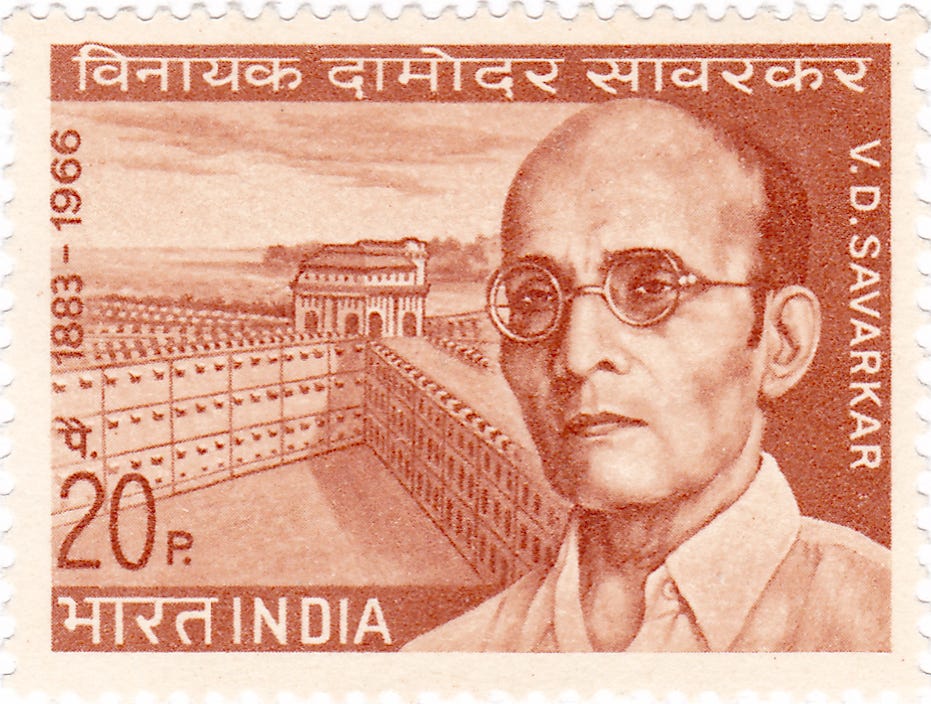
In Review: Savarkar and the Making of Hindutva. Janaki Bakhle. Princeton University Press, 2024. 512 pages.
Introduction
A century after Essentials of Hindutva (1923), Vinayak Damodar Savarkar has moved from the margins of Indian political discourse to its epicentre. This has led to a fillip in scholarly reassessments, both sympathetic and critical, of his legacy, reflecting a broader impetus to capture the dominant narrative of national discourse. Critics read Savarkar as a compromised freedom fighter who wrote mercy petitions, became subservient to the British government, and incentivised divide-and-rule by devising the so-called exclusionary ideology of Hindutva. Sympathisers defend Savarkar as a symbol of sacrifice, a thinker who was the fountainhead of both the revolutionary movement and Hindutva, an ideology representing the impulse of the Indian civilisation. The subject at hand is currently torn between the two portraits.
Savarkar and the Making of Hindutva (2024) by Janaki Bakhle is conceptualised as an attempt to surpass the intellectual deadlock. Bakhle aims to ‘bypass the partisanship’ and ‘bring Savarkar to the reader as much as possible’ through his own words. The literature produced by and on Savarkar is primarily in two languages: English and Marathi. However, Savarkar’s writings in Marathi have seldom been analysed for the larger audience that reads in English. Bakhle contends that the Marathi corpus has largely eulogised Savarkar, while scholars working in English have largely condemned him. This is where the author, with her Marathi background, brings the erstwhile obscure corpus to the fore. In doing so, she attempts to bring the global and regional discourses onto the same plane. Bakhle’s ambition with the book is to explore Savarkar as ‘a major contributor to modern Indian intellectual and political history’, focusing on the ideas he set in motion, moving beyond the statics of history (p. 10).
Apart from the dominant English narrative, the Marathi corpus unlocks access to other important facets of Savarkar: the poet, the playwright, the columnist. Bakhle argues that a figure of this range cannot be reduced to a single label without losing the whole. To resolve this, she adopts the ‘kaleidoscopic gaze’, a method that looks into all the contradictory pieces simultaneously rather than isolating them one facet at a time. The object is to keep ‘turning the kaleidoscope’, watching how contradictory ideas and contexts rearrange themselves as new patterns emerge. Each mode of expression of Savarkar carries its own idiom, and in the passage of ideas between them, the structure of his thought becomes legible. The contradictions that emerge are accepted as constitutive of Savarkar’s identity.
The six chapters across the book examine the six different Savarkars. The first reconstructs the revolutionary through the colonial police archives. The second follows the so-called anti-Muslim and anti-Gandhi polemicist who found his cause in the Khilafat agitation. The third turns to the caste reformer battling orthodoxy as a Brahminical insider. The fourth reads the nationalist poet whose poetry permeated all his works. The fifth examines the nationalist historian who wrote for teleological ends rather than academic rigour. The sixth traces the obscure Marathi hagiographic corpus, consisting of memoirs, biographies, and devotional writings, which elevated the man to legend. The narrative stops in 1937, when Savarkar was released from detention. The timeline clearly concerns itself with ‘the making of Hindutva’ rather than its mechanics through the post-1937 Hindu Mahasabha politics.
Bakhle’s methodological intervention is ‘critical distance’, an approach she contends is found wanting in Savarkar’s hagiographical assessments. This also defines the standard against which the book should be assessed, and against which, in my judgement, its central arguments lack precision. The difficulty lies in the uneven application of distance. The examination is thorough and rigorous towards Savarkar and his biographers, at times less so towards the book’s own inferences. At the crucial load-bearing junctures, suspicion is steelmanned as a dictum, and motives are loosely ascribed to the subject. These problems are best described not sequentially, chapter-wise, but as four themes that capture the consistent output of each kaleidoscope turn and recur, often with their own share of problems.
The first is ‘The Gandhian Antithesis’, in which Bakhle’s Savarkar is constructed in opposition to Gandhi, who throughout the book serves as its coordinate against which the deviations are measured. The opposition to Gandhi, the representative of predominantly humanist values, serves as a phenomenon that marks what Savarkar deviates from and becomes a method of judgement. This is not a simple lionisation, as Bakhle is critical of Gandhi on caste and his historiography. But on the axis that carries more moral weight in the book, which is the treatment of Muslims and the destiny of secularism in India, the asymmetry gets stark. The second is ‘The Anti-Muslim Polemicist’, where the book’s method of reading through Savarkar’s own words lives alongside her consequential omission: Muslim politics as an independent actor, with its own goals and ambitions, and not as mere simpleton objects of British divide-and-rule. The third is, ‘The Caste Paradox’, which the book concedes with one hand and takes away with the other through its boldest and least supported argument around the terms of Savarkar’s release and detention. The fourth is ‘The Anti-Colonial Legacy’, the smallest of the four in the book’s economy, but a definitive exhibit of the book’s methodology. Taken in turn, these capture the longitudinal constants that emerge on each rotation of the kaleidoscope.
The Gandhian Antithesis
Though Gandhi’s name appears in no chapter title, he is the book’s silent benchmark. In the introduction, Bakhle argues that Savarkar wrote Essentials of Hindutva in 1923 in response to Gandhi, assuring the larger Hindu community that ‘even if Gandhi was gone, a finer, better, more authentic man was ready to lead, from a region with prior experience of having struck the first blow against three different foreign invaders: Muslims, the Portuguese, and the British. Maharashtra’s history, he wrote, offered a better model for an ongoing nationalist struggle than what Gandhi was offering’ (p. 16). But that is looking at Savarkar in 1923 through the lens of who he became by 1937. The truth is, when he wrote this tract, he published it under a pseudonym, ‘A Maratha’. He was still a convict, staring down nearly 40 more years in prison, and about to promise that he would stay out of politics for good. This is not exactly someone lining up to take Gandhi’s place, and he never puts his name behind the claim either. Essentials of Hindutva reads like an ideological answer to Gandhi, a different vision of the nation put forth when actual leadership was not possible. Savarkar was probably the last person who could act on such a manifesto, under the uncertainty of captivity, which is why he wrote it as one.
The benchmarking continues to surface at various stages in the book. In the first chapter, Bakhle argues, ‘One of the ways Savarkar was useful to the British government was in his consistent attacks on Gandhi, who was the most prominent political figure advocating Hindu-Muslim unity’ (p. 68). In the second, she writes, ‘Khilafat was in some respects a gift for him, providing him with a political cause he could use to intervene in the nationalist debate, rebuild his name, and quickly make up for the time he had lost when imprisoned in the Andamans. The Khilafat movement gave him something concrete with which to confront Gandhi’ (p. 114). Again, she asserts that while Gandhi was trying to soothe communal tensions, Savarkar was willing to keep them inflamed (p. 116). In the conclusion, she charts the displacement of the ‘Gandhi-Nehru Vision of Secularism’ or the sarva dharma sambhava by Savarkar’s ‘dread-secularism’ (p. 415).
The antithesis is normative in structure. In Bakhle’s framing, opposition to Gandhi runs through Savarkar’s colonial usefulness. His attacks on Gandhi are named as one of the ways he was useful to the British. The assumption that any critique of Gandhi automatically serves British interests casts all figures critical of Gandhi in a negative frame. By this standard, the revolutionaries who opposed Gandhi from a still more radical position would have been the natural beneficiaries of British patronage. They were not. The reason is obvious: the quarrel between the revolutionaries and Gandhi was not over whether to combat the British Raj, but how it should be done. Their existence definitely divided the nationalist camps, but the reason was ideological, and the differences were not neatly zero-sum for the freedom movement.
After his release from jail in 1924 and the commencement of his detention in Ratnagiri, Savarkar wrote caustic articles against Gandhi, freely available online as The Gandhian Confusion. In the articles, Savarkar’s accusations were clear: Gandhi was useful to the British and single-handedly responsible for blunting the freedom movement (Gandhian Confusion, p. 15). Even a single article from his collection, ‘The Sympathiser of the British’, can encapsulate it, where Savarkar writes, Gandhi alone ‘can dissuade the people from the path of the revolutionaries, which the government fears like a deadly poison, and protect the British Empire socially, religiously, industrially, and educationally in a way of relatively minimum loss and maximum convenience’ (Gandhian Confusion, p. 15). In a curious turn of events, almost a century later, the charge has been inverted onto its author. Bakhle levels the same accusations, and does so without engaging the articles that opposed Gandhi.
The evidence in itself is antithetical to her framing. The same essays that attacked Gandhi were openly anti-British and supportive of the revolutionary movement. In the series, he celebrated the Congress’ adoption of the resolution for complete independence, despite a hesitant Gandhi (Gandhian Confusion, p. 17). The government later banned his anonymous outlet, Shraddhanand, in 1930 for its seditious content and open defence of the revolutionaries. In 1929, the newspaper was already listed by the Home Department of the British government as ‘anti-Government in tone’ (National Archives, Home Political, 1930). Then, in 1934, in the Sweetland Case, Savarkar was taken into custody for two weeks but was released for lack of evidence. It is difficult to comprehend how Savarkar was useful to the British by being more virulently anti-British, which consequently led to the banning of his newspapers. Was it a lack of assessment by the government, or a miscommunication between the two parties on the ‘incentive’ behind the release? What is left is a reading that attributes motive to fit a predetermined conclusion, notably by skipping the Marathi articles, which Bakhle claims are a distinctive feature of her book.
In the second accusation, the Khilafat movement is framed as Savarkar’s opportunity, while airbrushing any discussion of Gandhi’s experiment and its consequences. Savarkar is portrayed here as strongly motivated by personal ambition with a desire for career rehabilitation rather than by intellectual, ideological, and civilisational reasons. The consequences of the Khilafat movement were stark. Gandhi’s decision to anchor the non-cooperation movement on the Khilafat cause achieved three things in effect: it conceded that the Indian Muslim political loyalty had a legitimate extraterritorial dimension; it lifted the ulama into mass politics on terms that enhanced their religious and political authority while repelling the moderate Muslim leaders; and it released an insurmountable religio-political energy which was difficult for the Congress to contain or direct. The Moplah violence of 1921 and over 100 communal riots in the 1920s were not incidental to that gamble but among its consequences. Reading Gandhi as attempting an experiment to defuse communal friction is defensible, but to treat the collapse of his experiment as incidental rather than as the political rupture that Savarkar was responding to is to decide in advance that his response can only look like opportunism.
The reasons for such speculations are unclear. This framing is more clearly articulated by Bakhle in her journal article ‘Country First?’ (2010), where she writes, ‘If we are not to allow the Hindu Right to take, own, and use the historiography of Savarkar, we need to take seriously his skill in the marshalling of arguments that had perhaps more elemental power than Gandhi’s, that could be read as more or less benign or dangerous, depending on context, interpretation, and the colonial conditions of India’s national history’ (Bakhle, Country First, p. 186). The passage is candid about its motive. There is a ‘we’, and there is a Hindu Right that the ‘we’ is set against. The purpose of engaging with Savarkar is to keep the other side from claiming him. Which side, then, is the ‘we’? The passage suggests that it is the Gandhian side whose historiography is to be protected. If the pieces were set from the beginning, this would not be ‘critical distance’ but a position that is clearly taken. Bakhle’s declared intent to stand outside the ‘binary’ camps would be more credible if the kaleidoscope were itself neutral. The kaleidoscope she offers as guarantor of that stance is apparently not.
The Anti-Muslim Polemicist
The second chapter, ‘The Fearful Demagogue’, is based on Savarkar’s own writings as they dictate the movement of the chapter. It builds on the first chapter, which asserts that it was useful to release Savarkar, partly because he could further the British government’s divide-and-rule agenda. The Khilafat movement, it is claimed, allowed Savarkar to unleash his rage against the Muslim community. The ‘opportunism’ is the core charge against Savarkar here. This claim is predicated on the assumption that Savarkar was also already a devoted anti-Muslim ideologue since his London days.
Bakhle cites Syed Haidar Raza, Savarkar’s fellow resident at India House, as having deposed to the British police that the latter could not keep the ‘anti-Mohammedan’ note out of his speeches (p. 47). This is offered by Bakhle as evidence that Savarkar was never a votary for Hindu-Muslim unity. The effect is to render Savarkar as an anti-Muslim ideologue from the beginning, one for whom the Khilafat was merely the awaited occasion. Raza’s account is only partly accurate. Savarkar, as studied from other accounts, did carry an early scepticism towards the Muslims. Whether he entirely believed in it is questionable given the numerous incidents around it. The recurring themes of Savarkar’s speeches were the Marathas and the Sikhs against the Mughal Empire, and the subsequent 1857 ‘War of Independence’. His idea was that the Hindus and the Muslims were involved in a constant cultural tussle throughout the Mughal period, which peaked during Aurangzeb’s rule. But after the end of his reign, the communal friction eased, leading to the Hindu-Muslim unity epoch of 1857. Savarkar’s 1857 book, on which he worked from 1907, is conceptualised precisely as a historical precedent for Hindu-Muslim unity. Its thesis is explicitly a case for Hindus and Muslims having fought as brothers-in-arms in 1857, and that Bahadur Shah Zafar, chosen by both communities, was therefore a legitimately Indian sovereign rather than a Mughal one. To Savarkar, 1857 marked the end of all Hindu-Muslim friction and served as an ideal template for their togetherness. The argument was offered in good faith against the establishment of the Muslim League and their lobbying for separate electorates, citing distrust of the Hindu majority. It would serve to bridge the gulf between the Hindus and Muslims who had largely taken a separate political course.
Savarkar highlighted the 1857 model in his article ‘Wake Up Sons of Islam’, published in The Gaelic American on 8 December 1906, to persuade Muslims to abandon the separate path and join hands with the Hindus as brothers against the British. The article urged Muslims to abandon their fear of a civil war from the Hindu side since the 1857 war implied that the Hindus and Muslims could see each other with a spirit of trust and brotherhood. Another crucial piece of evidence that completely negates Raza’s accusation is the episode of 13 September 1908, when Lala Har Dayal, in a speech at the India House, declared that he was working for a Hindu India and that Muslims who wished to remain in the country would have to worship Hindu gods (National Archives, Home Political, 1908). Savarkar publicly opposed Har Dayal’s speech, called it dangerous to the national movement, and proposed a formal discussion of the question. If Savarkar was agreeable to the idea, he could have remained silent. Instead, he opposed this position within his circle to defend the place of the Muslims in Indian polity.
This is not to say that the pre- and post-Andaman Savarkars cannot be reconciled ideologically. Much of the recent scholarship, most notably by John Pincince, Vikram Visana, and Vinayak Chaturvedi, connects the two phases. The above argumentation intends merely to highlight that Savarkar was willing to change his opinions on the matter. It suggests the larger possibility that Savarkar’s intellectual salvo of Hindutva emerged as a by-product of the fractures he saw in the Indian polity over the next decade, be it the Morley–Minto reforms in 1909, the Lucknow Pact’s assent to separate electorates in 1916, and, above all, the Khilafat and the Moplah.
There is another side to the ‘Khilafat as a gift’ framing. Bakhle writes that ‘Savarkar wrote to keep the memory of Khilafat, and thus communal feeling, alive’ (p. 116). Two inferences follow from this reading: first, Khilafat becomes a ‘one-off’ episode of communal enthusiasm that the Muslims briefly indulged and then moved past; and second, it erases Muslim political agency from the picture. It is thus only Savarkar’s writings that keep fanning the fire. However, it must be understood that the political history of Indian Islam, though not without its diversity, is not inert. From Ziauddin Barani to Shaikh Ahmad Sirhindi to Aurangzeb’s Fatawa-e-Alamgiri to Shah Waliullah Dehlawi to the Third Battle of Panipat to the 1857 rebellion, Muslim political agency showed clear will and purpose. After 1857, from the Hindi-Urdu controversy to Sir Syed Ahmad Khan’s ‘two-nation theory’ to the backlash against placing Hindi on an equal footing with Urdu in 1900 to the backlash against the revocation of Bengal’s partition in 1911, Muslim political agency recalibrated itself strategically, shaped by memories of its pre-1857 supremacy. The politics of separate electorates had become non-negotiable and synonymous with Muslim politics.
After 1923, Savarkar was responding to a real and dominant stream within Muslim politics, even if it was not the only one. However, the Muslims in both Savarkar’s and Bakhle’s writings are flat and monochromatic, albeit from opposing standpoints. Savarkar’s Muslims are attributed agency but generalised negatively; Bakhle’s Muslims are stripped of agency but generalised positively. Savarkar’s Muslims act with intent; Bakhle’s Muslims are acted upon by circumstances. Both portraits are single-cause readings of a community that was, in fact, divided over its own future in ways neither writer can quite capture without sacrificing the polemical force. History settled the question in a direction Bakhle’s framework cannot explain: the Muslims of Savarkar’s imagination secured their Pakistan, while Bakhle’s Muslims lacked the dominant agency to argue their community out of it.
The Caste Paradox
In the third chapter, Bakhle lays out the social backdrop against which Savarkar was set to implement his social reform ideas. Here, the author contends that Savarkar’s caste critiques were radical for his time. He spoke critically of cow worship, ritualism, and religious orthodoxy. The load-bearing part is her distinction between Ambedkar’s external critique of Brahminism and Savarkar’s internal one, which forms an enriching read. Here, she contends that Savarkar never engaged caste as a structure of power, and he never challenged Brahminism enough to dismantle it. The contention is that Savarkar was a Brahminical insider, as Bakhle writes, ‘Savarkar attempted to have it both ways: to enact radical reform without completely alienating the privileged elite. By suggesting a radical reduction of Brahminism—by bringing down the necessary rituals (saṃskāras) from the mandated 16 to only the essential three (naming ceremony, thread ceremony, and mourning), advocating marrying in a registrar’s office, and conducting one’s own rituals in Sanskritised Marathi—Savarkar believed it was possible to reconfigure and update Brahminism for the twentieth century’ (p. 170). Hence, she contends, Savarkar could project himself as a staunch reformist by radically reducing Brahminism, while simultaneously reconfiguring it for the twentieth century.
Bakhle wonders why Savarkar did not launch an anti-Brahmin campaign, as was the norm during those days. We will find, however, that Savarkar’s reading of caste was different. He considered it a system of graded inequality that predated the Brahmins and had already taken shape by the time they codified it, terming the phenomenon pothinisht jatibhed (Scripture-based caste discrimination). The evolution of caste, on his account, was natural: a spread of common practices adopted by all Hindus, and divided among them, for socio-economic reasons. Hence, the caste system was a feature independent of Brahmins or Hinduism as a religion. For Savarkar, the sin of retaining caste practices was on every community, even the lower castes. The empirical observation was accurate. The lower castes themselves had hierarchies, and the practice was pervasive enough that Buddhists, Christians, and Muslims had their own castes. These communities were not governed by Brahmin authority, and yet developed the same graded structure. The undoing of the seven shackles that Savarkar prescribed was therefore not addressed to any particular caste but to the entire Hindu fold, since the fold shared the problem in common. Savarkar went so far as to reject his own caste identity, asserting he belonged to only one jati—Hindu.
She poses a question to conclude the chapter (p. 230), ‘Was his agenda of caste reform of any real use to the victims of caste oppression, prejudice, and violence, or was it a way of establishing his progressive credentials in provocative but ultimately nonconsequential ways? And was his real intention to subordinate caste distinctions to a broader category of Hindu for the major reason that he thought this was the only way to take on the Muslim threat?’ She proposes an answer. For her, Savarkar wishes away the problem of caste through ‘a unique mixture of outrageousness and rhetorical bluster’ (p. 230). On close reading, Bakhle offers the reader two possibilities and invites them to choose. The first meant that the reform was undertaken for Dalits themselves, with the intention of giving them real relief. The second meant that the reform was just a cover for consolidating the Hindu community against the Muslims. Bakhle’s insistence is towards the latter, as he and his ‘followers carried the vestiges of an ineradicable Brahminism along with his ever-present anti-Muslim refrain. Like him, they downplayed the structural significance of caste while naturalising everyday prejudice against Muslims’ (p. 231). The reading is supported by her selection of passages, which favours those where the Muslim theme is proximate.
Savarkar’s actual position, on an exhaustive reading of his social reform corpus, fits neither of Bakhle’s two boxes. Her binary framing, which treats ‘for Dalits’ and ‘for the whole’ as separable purposes, is what Savarkar denies. The Muslim strand only intensifies the urgency by adding an external stake. It is not supposed to be the primary rationale for reform. Savarkar was essentially answering a larger question, of which social reform became an important and radical element, which was: what makes the national organism whole, in a polity whose basis is an integrated body of the nation? The dissolution of jatis into a single Hindu identity would have to pass the hard test of ameliorating the Dalits. Savarkar is pitted against Ambedkar, whose essential question is: what makes citizens equal, given that the moral standing of persons is before and independent of the collectives to which they happen to belong? His answer was a civic-egalitarian approach in which the nation is constituted by equal citizens whose worth does not depend on their membership in the collective. The mechanics were ‘the annihilation of caste’ and later an exit from the Hindu fold, since caste was difficult to annihilate from within. That Ambedkar’s Navayana Buddhists are still tied to their ancestral jatis, and still identified with their legal caste in the modern state, does not make the approach radically powerful against Savarkar’s gradual approach to ‘caste agnosticism’. Both are gradual, not immediate, approaches to making caste irrelevant.
Savarkar’s failure to meet the civic-egalitarian standard is presented by Bakhle as a downside. It is deemed ‘superficial’, ‘instrumental’, ‘co-optation’, with no acknowledgement that the standard itself is contested. Savarkar did not value Dalits as ends in themselves, as he was answering a different question. This is a standard of Ambedkar’s moral world. In his worldview, Savarkar would have to reform caste in the desire of national vitality predicated on Hindu fraternity, regardless of whether there was a Muslim threat. Reading Savarkar as an anti-Muslim polemicist strengthens Bakhle’s conclusion. The complete corpus complicates the reading. If Savarkar’s words are to be taken as honest, in his last interview in 1965, he imagines a future India where ‘The Hindus would be a casteless society, a consolidated and a modern nation’ (Sampath, 2021).
The Anti-Colonial Legacy
Bakhle acknowledges, contrary to much of the prevailing literature, that Savarkar’s mercy petitions were strategic rather than tokens of subservience, and that his anti-colonial credentials never withered. But his legacy, according to her portrayal, is blemished. By detaining Savarkar, the British government was able to curtail the anti-colonial aspect of his politics. What was left in him, henceforth, was the useful part: an anti-Gandhi and an anti-Muslim polemicist. Such a man was better off detained and allowed to write articles which would ultimately benefit the British. We have dealt with the claims in the preceding sections. The contradictions are already laid bare, but they have not been discussed directly as Bakhle wants to explain them.
She writes (p. 66), ‘The Ticket of Leave would have been the perfect solution for Savarkar and his brothers. Leaving them in the distant Andaman Islands would have let the government claim it had given him clemency while simultaneously removing him from Indian political life. Why then would they release him into house arrest in his native state of Maharashtra when his most incendiary writings were all in Marathi and, since Savarkar wrote under assumed names and published widely in his associates’ journals, he would be very difficult to monitor? Indeed, by the time watchers and translators had confirmed that those incendiary writings were penned by him, the damage had been done.’
Bakhle raises grave questions which need thorough examination. She is making a case for ascribing motive to the British government in releasing Savarkar to his native state, Maharashtra. However, firstly, Savarkar’s transfer to Indian jails in 1921 was not due to clemency. He was still to continue with his life imprisonment sentence. The release happened due to the reforms suggested by the Jails Committee Report, following which the communique from the Secretary to the Government of India on 12 March 1921 was, ‘The Government of India have now decided that in view of the criticisms of the Jails Committee regarding the conditions obtaining in the Andamans, it is no longer possible to retain political prisoners there. All local Governments are accordingly being instructed that their political prisoners must be removed as soon as practicable’ (National Archives of India Home Department, 1921). Why was he brought to Maharashtra, then? The answer is simple: his case was administratively under the Bombay Presidency and was the responsibility of the Government of Bombay. Whenever Savarkar’s mercy petitions and the question of remitting his sentence had come up in earlier years, especially around the 1919–1920 Royal Amnesty, it was the Government of Bombay that constantly refused his release, citing him to be ‘dangerous’. This position was held until 1921, when the Government of India strictly pressed for implementation of the Jails Committee’s reforms. Even then, the transfer to the province of origin was to be a cumbersome exercise, since several dangerous political prisoners remained in the Cellular Jail after being omitted from the Royal Amnesty. The June 1921 Home Department record shows the enormity of the exercise: the political prisoners then awaiting transfer from the Andamans were 2 from Maharashtra (the Savarkar brothers), 13 from Bengal (primarily Jugantar and Anushilan Samiti revolutionaries), 18 from Punjab (primarily Ghadarites), 13 from Burma, and 2 from the North-Western Frontier Provinces (National Archives of India Home Department, June 1921).
Vikram Sampath’s biography, the book Bakhle, criticised for lacking critical distance, is clear on this. The choice of Ratnagiri was again to hinder Savarkar. Sampath mentions that Bombay, Poona, and Nashik were ruled out due to their political sensitivity. Ratnagiri was selected because it was small, remote, and offered the least scope for political activity. The conditions of release, that is, confinement to the district and abstention from political activity, were not just token. In Savarkar’s case, they were reinforced repeatedly over five terms, spanning 13 years.
The speculative leap could have been avoided if not for the book’s uniform teleological structure, which rested on Savarkar’s utility against all the good things of the freedom struggle: Gandhi, the Congress, the Muslims, and the fabled Hindu-Muslim unity. Hence, coherently enough, the speculative approach is continued. Bakhle alleges, ‘We cannot tell what use the government might have made of him, forestalled as it was by Savarkar’s claim that he would no longer engage in political activity. But we can suspect that they had plans to use him or would have liked to have used him’ (p. 68). The ‘utility’ is already established. She continues, ‘The result was that Savarkar wrote and said whatever he wanted, then argued with the police when challenged. The police could have rearrested him, moved him, watched him more carefully, but instead, as we will see, they simply wrung their hands. They enabled Savarkar to continuously attack Gandhi, Khilafat, and what it meant to Muslims, and everyone who did not support his agenda’ (p. 69).
The way the 13-year detention played out is contrary to Bakhle’s thesis. If the British had wanted Savarkar’s incendiary output, their conduct is difficult to explain. When he published ‘The Suffering Moslems of Kohat’ in 1925, he was warned that his life imprisonment sentence would be resumed. The reason is counterintuitive if divide-and-rule is kept as the norm: the article was ‘bound to inflame the feelings and increase the tension between Hindus and Muhammadans’. When his play Sangeet Ushap (1927) was found to carry anti-Muslim undertones, he was warned again. After the second warning, he stopped publishing so-called anti-Muslim material under his own name.
From 1927, Savarkar continued to write articles against Gandhi and the Muslims pseudonymously through a newspaper, Shraddhanand, which his younger brother, Narayan Savarkar, was entrusted with operating. This was his last resort to continue voicing his opinions, albeit without his name on the articles. Now, the government could not be charged with encouraging Savarkar to write incendiary articles, and the latter could continue writing under the veiled outlet. But as we know, the newspaper was banned within three years. Savarkar lost his anonymous outlet, and his anti-Gandhi and so-called anti-Muslim writings ceased.
For a man Bakhle describes as useful to the British, Savarkar had a difficult time of it. He was warned repeatedly, denied the ability to write under his own name, had his detention renewed across five successive terms, had his newspaper banned, and was left with social reform as the only subject he could openly discuss. This raises a question: if the British were so certain of Savarkar’s utility, why did they withhold his full release for 13 years? A politically active Savarkar, free to build an organisation and address audiences directly, would have opposed Gandhi and the Muslims to far greater effect than by writing pseudonymous articles in a small Marathi paper. If the government was pleased with his output, which included the revolutionary standpoint in his articles, it could have accepted, even welcomed, an out-in-the-open Savarkar. It did not. The full release came only in 1937, at which point Bakhle’s narrative ends.
Conclusion
The four themes tracked in this review point to a single pattern. The resulting portrait is reminiscent of earlier critical works on Savarkar, which centred on his opposition to Gandhi and Muslims. However, unlike other such works, Bakhle is clear about Savarkar’s anti-colonial commitment. She also does not perpetuate the ‘Savarkar lived on British pension’ debate, clearing the blemishes from his commitment. This brings her to the three core characteristics of Savarkar’s ideological axis: anti-British, anti-Muslim, and anti-Gandhi.
Bakhle’s work on Savarkar is valuable because it offers glimpses of what a good book on Savarkar would look like. It engages with his complete corpus, including the much-neglected works in Marathi, digs the archives, understands the importance of Savarkar’s poetry, concedes him a primary-source-backed continuous anti-colonial credential, brings a scholarly lens to analyse Savarkar’s social reform, and attempts an intellectual analysis of ‘the Making of Hindutva’. The kaleidoscope, despite its biases, has been an innovative tool for analysing Savarkar and for accepting all his diverse facets, which is why the book’s scope is enormous and possibly unparalleled, albeit limited to the pre-1937 phase. Bakhle’s instinct to bypass the binaries around Savarkar and trust the primary sources deserves appreciation. An improvement on this work will have to surpass the great methodological rigour displayed in Bakhle’s work. But a fresh corrective would have to inculcate greater discipline in examining the faulty hypotheses.
Apratim Tripathi is a research fellow working on VD Savarkar at the Accelerating India Fellowship

Very well written, Apratim. Looking forward to reading your book soon.
Extremely well-written review, considering the length it's written.