

Prospective contributors can find our list of books here.
Please adhere to the following commissioning policy of the New Delhi Review of Books (NDRB). It is to be read alongside the Style Guide.
Contributors whose work is published receive an honorarium within a month of publication.
1. Overview
The NDRB commissions critical reviews of books from its curated list. Commissions are awarded based on a formal proposal process.
The editorial correspondence between the NDRB and a commissioned author is governed by the terms set out below, together with any written correspondence confirming the specific terms of a commission (including timeline, structure, and honorarium) as agreed with the Editor-in-Chief.
2. The Proposal Process
The NDRB does not accept unsolicited complete drafts. All commissions must be preceded by a formal proposal. Contributors are invited to consult the list of titles available for review before submitting a proposal.
Proposals must be submitted to:
Each proposal submission must include the following:
The title from the NDRB’s listed selection that the contributor wishes to review, together with a brief note on their familiarity with the book or the author’s broader body of work.
A short synopsis of the critical angle or argument the contributor intends to develop in the review, of between 150 and 200 words. The synopsis must present a clear argument bearing on the book’s significance, its limitations, or its contextual relevance to India, or offer a rigorous academic critique. Mere description or summary of the book, and proposals lacking argumentative rigour, will not be considered.
A short biographical note, including any relevant academic or literary background, with a full curriculum vitae attached.
A proposed timeline for submission of the complete review.
Proposals must be at least 500 words in length and submitted in .docx format. If no response is received within two working days of submission, the proposal should be considered rejected.
3. Commissioning
Upon acceptance of a proposal, the timeline, structure, and honorarium will be confirmed in writing with the Editor-in-Chief before the full draft is undertaken. No draft should be commenced before such confirmation.
Once commissioned, the author may not submit the piece, or any substantially similar version of it, to any other publication for consideration. Upon acceptance of a submission, the NDRB reserves all publication rights to the piece.
If the proposal or discussions from the meetings are not reflected in the submitted draft, or if the draft does not meet the publication standards, the NDRB reserves the right to cancel the commission.
4. Deadline and Late Submission Policy
Contributors are expected to submit their completed review by the deadline agreed with the Editor-in-Chief at the time of commissioning. The NDRB recognises that unforeseen circumstances may arise; however, timely delivery is essential to the editorial process.
4.1 Late Submission: Honorarium Reduction
Where a commissioned review is not submitted by the agreed deadline, the following honorarium reduction schedule shall apply:
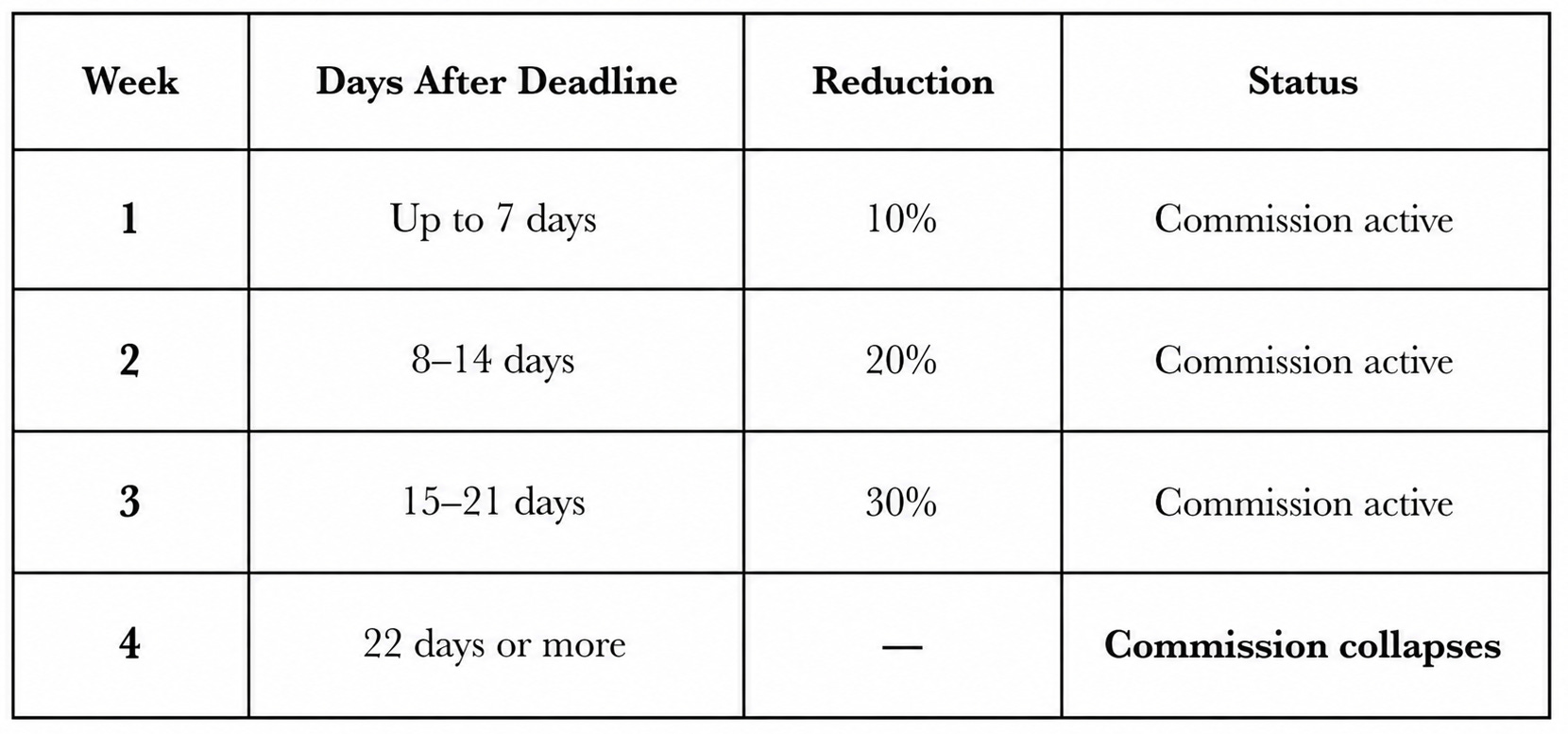
Reductions are cumulative and apply to the total honorarium agreed at commissioning. This also applies to the edited documents sent back for revisions.
5. Requirements for the Complete Review
All submitted reviews must comply with the following requirements. Contributors are strongly advised to consult the NDRB Style Guide before commencing work on their draft. All contributors are to note that our publication finds itself at the intersection of academia, politics, and policy.
We encourage the reviewers to go over the Claremont Review of Books and our previously published review essays to understand our vision and approach.
5.1 Length
Reviews must be a minimum of 2,000 words. The final word count should be discussed and agreed upon with the Editor-in-Chief.
5.2 Language
All reviews must be written in English. The NDRB follows British English conventions throughout. Reviews of books originally written in any language are welcome; contributions reviewing books in regional and foreign languages are particularly encouraged.
5.3 Format
File format: .docx only. Submissions in PDF, .pages, .odt, or other formats will not be accepted.
Font: EB Garamond or Garamond, 12-point.
Line spacing: 1.5.
Alignment: justified.
References: all references and citations must be provided as hyperlinks to the primary source. Footnotes are not permitted. Endnotes may be approved at editorial discretion.
6. Use of Artificial Intelligence
The following policy governs the use of AI tools:
Permitted use: The use of AI for translation support, or as a sounding board for ideas, is acceptable, provided the intellectual labour, the argument, the voice, and the critical judgement remain entirely the author’s own.
Prohibited use: Work in which the prose, structure, arguments, or critical reasoning has been generated by an AI system will not be accepted.
The Editorial Board reserves its discretion in all matters about AI use. Suspected breach of this policy may result in rejection of the submission and cancellation of the commission.
7. Editorial Correspondence
All submissions and proposals should be addressed to:
© 2026 New Delhi Review of Books. All rights reserved.
